Book Synopsis
The 1%
Theory
Micro Shifts for Macro Transformations:
A Mindful Path to Real Change
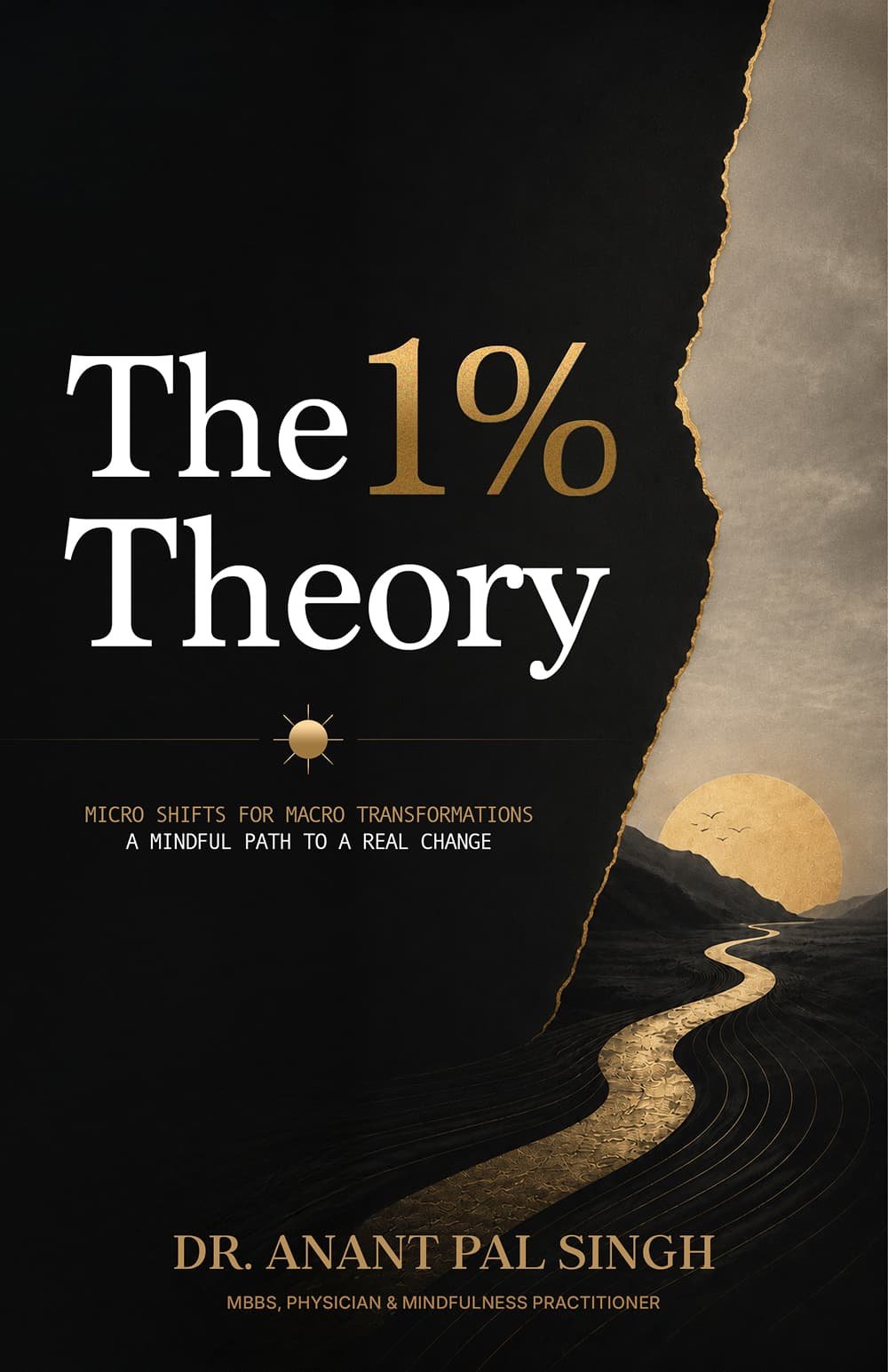 The 1% Theory
Book Synopsis
Micro Shifts for Macro Transformations:
A Mindful Path to Real Change
The 1% Theory
About the Book
What if the most profound transformation in your life required not a dramatic overhaul — but a shift of just one percent?
Written by physician and mindfulness practitioner Dr. Anant Pal Singh, The 1% Theory is a deeply personal and scientifically grounded guide to lasting inner change. Born from Dr. Singh's own journey — from a child with writing dyslexia who was misunderstood and ridiculed, to a physician who lost everything to bankruptcy overnight in 2007, to a man who rebuilt himself one micro-moment at a time — this book offers a radical and compassionate alternative to the relentless self-improvement culture that leaves so many people more exhausted than transformed.
At the heart of the book is a simple but powerful idea: the smallest conscious shift — done with presence, not pressure — can change everything. Dr. Singh explores this through seven universal human struggles: burnout, loneliness, addiction, emotional turbulence, broken relationships, the confusion of success, and the loss of self. Rather than treating these as problems to fix, he approaches each as a signal asking for alignment — and offers practical, science-backed microshifts to meet each one.
Drawing on neuroscience, clinical experience, and his own lived philosophy, Dr. Singh introduces readers to three interconnected frameworks: the Mind-Brain-Body Matrix (MBBM), which explains how thoughts, neural wiring, and bodily sensations continuously shape lived experience; Zero Fault Mode (ZFM), a way of meeting setbacks with curiosity rather than self-punishment; and the 1% Daily Compass — a practice of Identify, Activate, Operate — designed to anchor clarity into everyday life. The book closes with four guiding Sutras of Happiness — Contentment, Stimulation, Equanimity, and Giving — offering a philosophy of wholeness that endures beyond any single insight.
The 1% Theory is not a book of hacks, morning routines, or motivational promises. It is an invitation to stop treating yourself as a problem to be solved and start remembering who you already are — 1% at a time.
What You Will Gain
Readers gain a clear, science-backed explanation for why willpower, productivity hacks, and motivational surges so often fail to create lasting change. By understanding how the nervous system, brain chemistry, and emotional patterns interact through the Mind-Brain-Body Matrix, you stop blaming yourself for "not trying hard enough" — and start working with your biology instead of against it.
Through the lens of seven universal human struggles — burnout, loneliness, addiction, difficult emotions, strained relationships, the confusion of success, and the loss of self — readers receive concrete microshift practices for each one. These are not techniques to master but small, accessible invitations to meet life's most demanding terrain with steadiness and self-compassion.
One of the most transformative outcomes of the book is developing the capacity to pause in the space between stimulus and response — what Dr. Singh calls the "last mile" of the 1% Theory. Readers learn how to interrupt automatic reactions in real time, whether in a sharp conversation, a moment of fear, or a familiar emotional trigger, replacing reactivity with deliberate, grounded choice.
Readers come away with a fundamentally different relationship with their own setbacks and imperfections. The Zero Fault Mode framework reframes every stumble as feedback rather than failure, dismantling the internal critic that blocks genuine growth. Over time, this shift from self-rejection to self-curiosity becomes the very soil in which sustainable transformation can take root.
Rather than chasing happiness as a distant peak to climb, readers finish the book with four enduring Sutras — Contentment, Stimulation, Equanimity, and Giving — that together form a living architecture of wellbeing. Supported by the 1% Daily Compass practice, these sutras transform abstract insight into a daily rhythm, making genuine fulfilment not a goal to reach but a way of being to inhabit.
Inside the Book
Where It All Begins
Real change doesn't start with bigger goals or harder discipline — it starts with one quiet moment of noticing. This chapter dismantles the myth of dramatic transformation and introduces the 1% Theory: the idea that the smallest conscious shift, done with presence rather than pressure, is where everything begins.
From Chaos to Calm
Burnout is not a productivity problem — it is your nervous system declaring that it can no longer sustain a life it was never designed to live. Through the Mind-Brain-Body Matrix, this chapter reveals why rest alone doesn't restore you, and how micro-alignments can bring you back from the edge without abandoning your responsibilities.
From Broken to Belonging
Loneliness is not the absence of people — it is the absence of being truly seen, and it often begins long before adulthood. This chapter traces loneliness to its roots in the "Thinking Child" survival pattern and offers a path back to belonging through micro-validations: small, repeated moments of recognition that rebuild connection from the inside out.
From Captive to Contented
Addiction rarely announces itself with a label — it hides in screens, busyness, approval-seeking, and the quiet compulsion to escape discomfort. This chapter looks beneath the craving to what is truly being sought, and shows how a 1% shift in awareness can interrupt the loop without shame or force.
From Overwhelmed to Regulated
Anger, sadness, shame, and fear are not enemies to be defeated — they are signals that carry precise information about what you need. This chapter teaches readers to hear what their emotions are truly communicating, transforming emotional overwhelm into one of the most powerful forms of inner intelligence.
From Fragile to Fulfilling
Relationships rarely break in a single dramatic moment — they erode slowly through small misalignments in how we listen, react, and show up. This chapter shows how the tiniest shifts in presence, tone, and attention can completely transform the quality of our most important connections.
From Struggle to Surrender
Success is not a peak to be climbed — it is an energy to be sustained, and most of us are pursuing a version of it that quietly empties us. This chapter invites a radical reorientation: from the relentless accumulation of more, to the deeply human experience of feeling grounded exactly where you are.
From Distracted to Directed
When the noise of performance, expectation, and survival accumulates long enough, the thread back to your own self can feel completely lost. This chapter is a guided return — not to a version of yourself the world approves of, but to the one you have quietly missed all along.
From Reaction to Response
Insight alone is not enough — the real test of growth arrives in a sharp comment, a sudden trigger, or a familiar fear in real time. This chapter bridges everything you have understood into lived intelligence: the capacity to pause in the space between stimulus and response, and choose consciously rather than react automatically.
The Full Circle
Happiness is not an emotion to be chased — it is an ecosystem to be cultivated through four enduring Sutras: Contentment, Stimulation, Equanimity, and Giving. This closing chapter brings the entire journey home, revealing that the wholeness you have been seeking was never truly lost — it was only waiting to be uncovered.
Reader Reviews
"I've read dozens of self-help books and always found myself back at square one within weeks. The 1% Theory is different. It doesn't ask you to become someone else — it asks you to notice who you already are. That quiet shift has stayed with me every single day since."
"The chapter on burnout alone was worth the entire book. Dr. Singh articulated something I had been experiencing for years but could never name. Reading it felt less like being taught something new and more like finally being understood."
"What struck me most was how honest Dr. Singh is about his own failures. This isn't a book written from a pedestal — it's written from the floor. And that's exactly what makes it so powerful and so believable."
"As a therapist, I recommend books carefully. The 1% Theory is one I return to again and again — not just for my clients, but for myself. The Zero Fault Mode framework alone has transformed how I approach my own inner work."
"I started reading this during a very dark period. The idea that I only needed to shift by 1% — not fix everything, not overhaul my life — gave me something I hadn't felt in a long time: permission to just begin. I'm still going, one breath at a time."
"The science is accessible, the stories are moving, and the tools are genuinely usable. I have recommended this book to my entire leadership team. If you want to understand how real change actually works — not just what it looks like — this is your book."
"You don't have to reinvent yourself. You only have to return to yourself — 1% at a time."
— Dr. Anant Pal Singh, The 1% Theory